
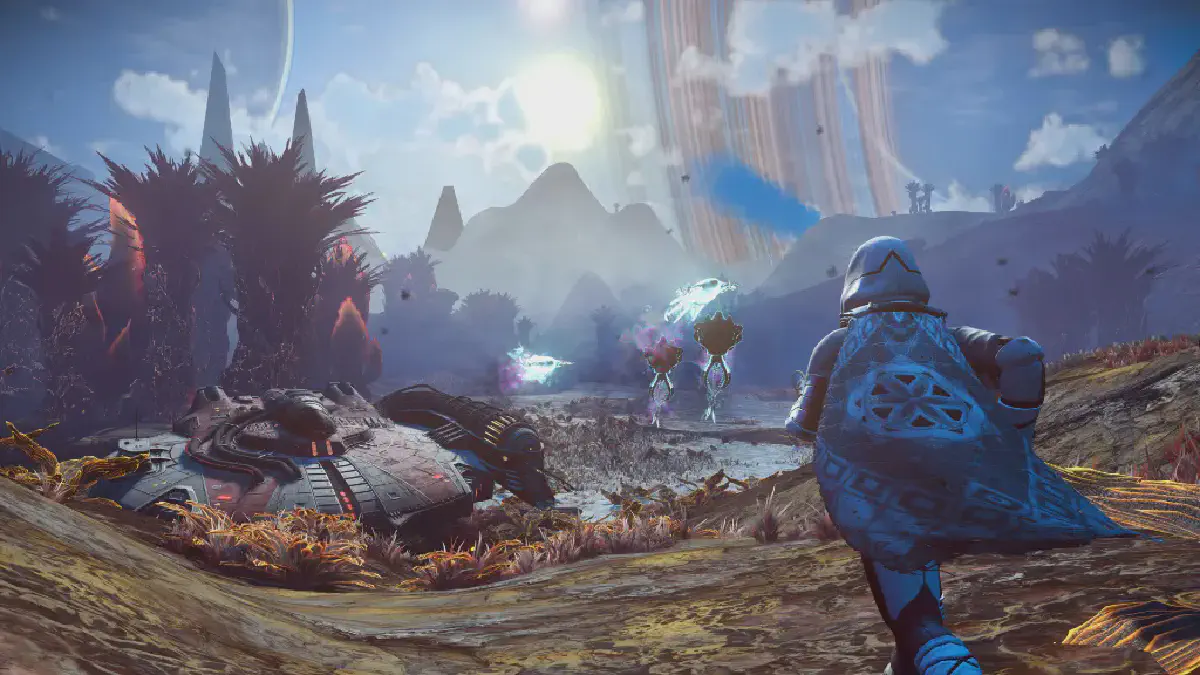

When No Man’s Sky launched in 2016, it was famously regarded as a disappointment. Now, in 2026, it stands as the gold standard for developer commitment and post-launch support. Let’s delve into what makes the current state of the game so spectacular.
The Endless Content Loop
In the previous updates, Hello Games dramatically overhauled the engine. Now, planets feature completely dynamic weathering systems that directly interact with your base building mechanics.
What Works
- The Exocraft System: Traversal has never felt better.
- Multiplayer Hubs: The Nexus is genuinely alive. It’s incredibly easy to group up with strangers and tackle massive raid-level Sentinel walkers.
- The VR Experience: Immersive is an understatement.
What Still Needs Polish
While near-perfect, the game still suffers from occasional inventory management bloat. You will spend a significant fraction of your time organizing elements into storage containers rather than exploring the stars.
The Engineering Feat: A Developer’s Perspective
From an architectural standpoint, No Man’s Sky is a masterclass in procedural generation at scale. Unlike most open-world titles that rely on pre-baked assets and static terrain, the “Atlas” engine utilizes deterministic mathematical functions (noise functions and fractal math) to generate entire solar systems on the fly.
As developers, we must appreciate the sheer optimization required for:
- Voxel-Based Terrain Deformation: Managing real-time edits to a procedurally generated mesh without causing massive frame-rate drops is a non-trivial physics problem.
- Streaming & Chunking: The game’s ability to transition from orbit to ground without a loading screen is a testament to highly efficient background data streaming and memory management.
- Redemption through Refactoring: The transition from the 2016 version to the 2026 version wasn’t just about adding features; it was a decade-long process of resolving technical debt and evolving a custom engine into a world-class simulation tool.
Final Verdict
I would recommend this game to anyone who enjoys exploration and adventure.
Therefore, I give it a solid 9.5/10.
It is a game that defined a generation of redemption arcs, and it continues to provide unparalleled exploration. If you haven’t jumped in yet, 2026 is the perfect time.